
The Complete History of Uji Matcha: 800 Years of Japan's Most Prestigious Tea
From a Zen monk returning from Song Dynasty China in 1191, to shogunate-protected gardens, Sen no Rikyū's transformation of the tea ceremony, and today's global shortage — the story of Uji matcha is the story of Japan's most enduring cultural obsession.
The Origins: Tea Arrives in Japan (1191)
The story of Uji matcha begins not in Uji, but in Song Dynasty China. In 1191, the Zen Buddhist monk Eisai returned to Japan from his studies in China, carrying tea seeds and a method of preparation unlike anything Japan had seen. Chinese Song-era monks had been whisking powdered tea (known as matcha or mo cha in Chinese) in bowls for centuries as a meditative practice, and Eisai recognised its potential to aid concentration during long meditation sessions.
Eisai's contemporary, the monk Myoe Shonin, took those seeds and planted them at Kosan-ji temple in Kyoto's Toganoo district — establishing one of Japan's first tea gardens. Myoe then encouraged cultivation in the Uji region south of Kyoto, where the soil, microclimate, and proximity to the Uji River created growing conditions that would prove uniquely ideal for tea.
📜 Historical Note
Eisai also wrote Kissa Yojoki (Drinking Tea for Health) in 1214 — the first book on tea in Japanese history. He presented tea to the ailing shogun Minamoto no Sanetomo, framing it as medicine. That medicinal framing persisted for centuries and is one reason Japanese tea culture took root so deeply in aristocratic and monastic circles.
Honcha vs. Hicha: Uji Earns Its Crown (Muromachi Period, 1336–1573)
As tea cultivation spread across Japan, a critical distinction emerged. Tea-tasting competitions called tocha became popular among the aristocracy and warrior class. In these contests, tasters competed to identify which bowl contained honcha(authentic tea) and which contained hicha (non-authentic tea).
By the Muromachi period, the classification became formalised and decisive: only tea from Uji and Toganoo qualified as honcha. Tea from every other region in Japan — regardless of quality — was categorised as hicha. This official designation, endorsed by the Ashikaga shogunate, effectively established Uji as the undisputed capital of Japanese tea culture.
The Ashikaga shoguns went further, establishing and protecting Uji's seven renowned tea gardens (Shichimeien). These gardens were cultivated under direct shogunal patronage, their produce reserved for the highest circles of Japanese society. One of these original gardens — Oku no Yama — still produces matcha today under the stewardship of Horii Shichimeien, founded in 1879, making it the sole surviving Muromachi-era Uji garden in commercial production.
The Invention of Shading: Uji's Greatest Discovery (15th–16th Century)
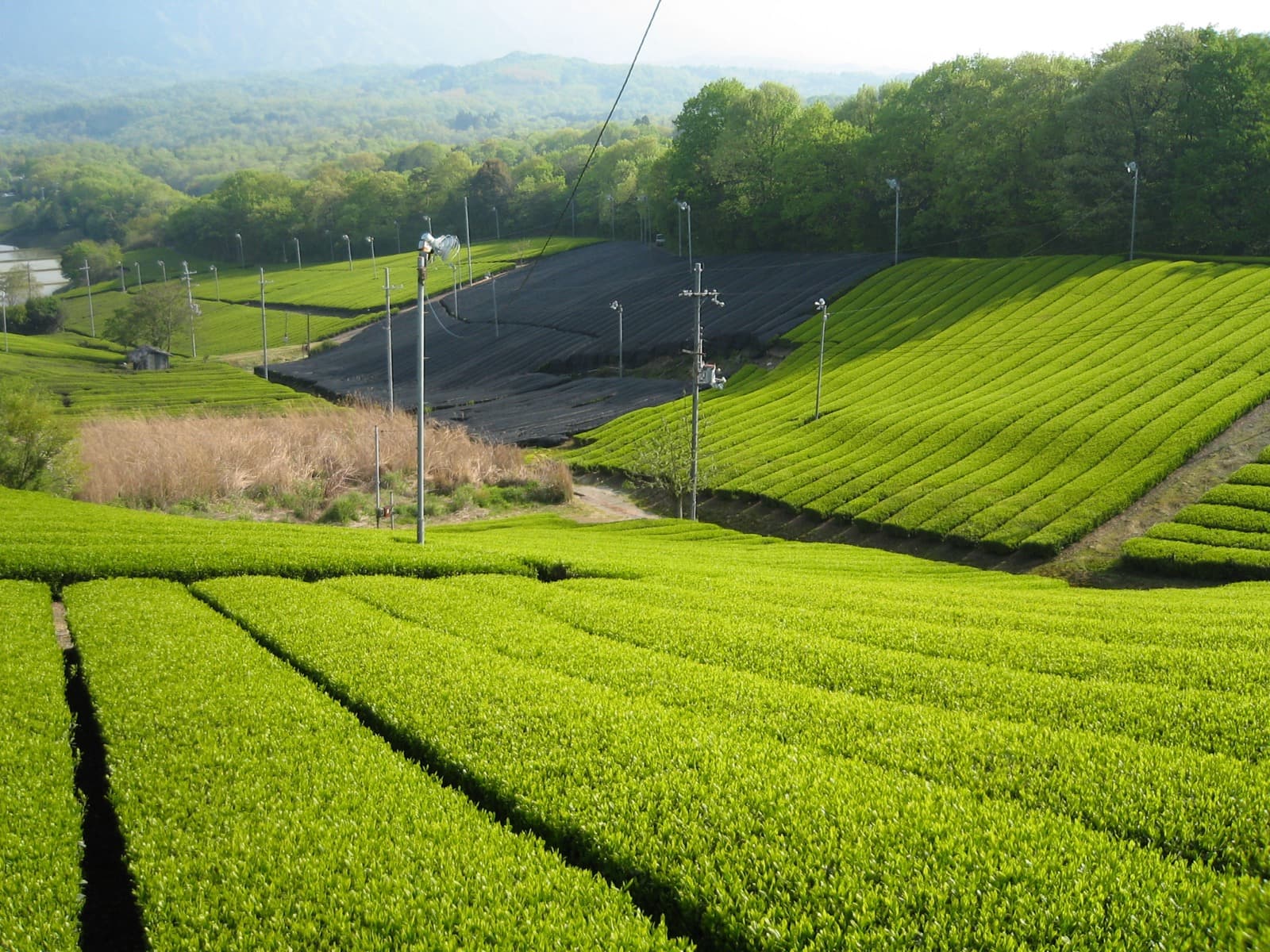
The most consequential agricultural innovation in Uji's history emerged in the 15th–16th centuries: oishita saibai, the practice of shading tea plants before harvest. The discovery is attributed to Uji farmers who noticed that tea plants growing in the shade of trees produced leaves with a dramatically different — and superior — flavour profile.
Farmers began covering their fields with reed screens and rice straw canopies, blocking 85–98% of sunlight for the three to four weeks before the first spring harvest. The effect on the plant is profound: deprived of sunlight, tea plants cannot convert the amino acid L-theanine into bitter catechins. L-theanine accumulates in the leaves instead, creating the characteristic deep umami sweetness that defines premium Uji matcha. Simultaneously, chlorophyll surges to compensate for the reduced light, producing the brilliant jade-green colour that sets Uji matcha apart visually.
🍃 The Science Behind the Shade
Modern analysis confirms what Uji farmers discovered empirically: shading for 20–30 days increases L-theanine content by 200–300% compared to unshaded leaves. L-theanine is responsible for matcha's calming focus — it works synergistically with caffeine to produce alertness without anxiety. The finest Uji ceremonial grades can contain up to 40mg of L-theanine per gram — more than double the content of unshaded green teas.
The traditional shading method using reed screens is called honzu (本簀) ortana-gake. It creates a living canopy with natural airflow and diffused light, producing deeper umami and greater flavour complexity than modern direct-cover synthetic nets. Today, honzu shading is practised by only a handful of farms in Japan — primarily in Uji's Shirakawa and Ogura districts. It is one of the clearest markers of truly premium Uji matcha.
Sen no Rikyū and the Perfection of Chado (16th Century)
No figure shaped the cultural status of Uji matcha more decisively than Sen no Rikyū (1522–1591), the tea master who served under the warlords Oda Nobunaga and Toyotomi Hideyoshi. Rikyū elevated the tea ceremony — chadō (the Way of Tea) — from aristocratic entertainment into a profound spiritual discipline rooted in the Zen concepts of wabi-sabi: finding beauty in imperfection and transience.
Rikyū's tea ceremony used Uji matcha exclusively. His four guiding principles — harmony (wa), respect (kei), purity (sei), and tranquillity (jaku) — became the philosophical foundation of Japanese tea culture that persists today. The three schools of tea ceremony descended from Rikyū's lineage (Urasenke, Omotesenke, Mushanokōjisenke) all continue to source their ceremonial matcha from Uji producers.
Rikyū's patronage cemented a truth that remains commercially significant in 2026: Uji matcha is not merely a product, it is a cultural artefact. When you drink ceremonial-grade Uji matcha from Ippodo or Marukyu Koyamaen, you are participating in an unbroken tradition that traces directly to Rikyū's tea room.
The Tokugawa Shogunate and the Great Tea Processions (Edo Period, 1603–1868)
Under the Tokugawa shogunate, Uji matcha achieved its highest institutional status. The shoguns organised elaborate annual processions called ocha-tsubo dochu— formal convoys transporting Uji's finest new harvest tea to Edo (modern Tokyo) in lacquered tea jars. These processions, which continued for over two centuries, ranked in ceremony and protocol just below the processions of the shogun himself.
The ocha-tsubo dochu established a cultural understanding that persists to this day: the first spring harvest from Uji is an event worthy of national attention. Today's equivalent is the scramble to purchase first-harvest Uji matcha from Ippodo and Marukyu Koyamaen the moment it restocks online — a 21st-century continuation of the same reverence.
During the Edo period, Uji producers also refined the stone-milling process. Granite stone mills were calibrated to grind tencha (the de-stemmed, shade-grown leaf) at precisely 40 grams per hour — slow enough to prevent heat build-up that would damage the delicate flavour compounds. This rate remains the industry standard for premium Uji matcha in 2026, and it directly explains why authentic stone-ground Uji matcha commands such premium pricing.
Meiji Modernisation and the First Exporters (1868–1945)
The Meiji Restoration opened Japan to international trade, and Uji tea producers were among the earliest exporters. However, Western markets initially preferred sencha (leaf green tea) over powdered matcha, which was unfamiliar. The major Uji houses established during this era — including Ippodo (founded 1717, internationally active from the Meiji period) and Marukyu Koyamaen — built their reputations primarily through the domestic ceremonial tea market and exports to the Japanese diaspora.
The post-WWII period saw significant consolidation in Uji's tea industry. Labour shortages and agricultural mechanisation pressured smaller producers. Many switched from traditional honzu shading to cheaper synthetic canopy covers. The handful of producers who maintained traditional methods — including Horii Shichimeien and Tsujirihei Honten — became increasingly rare, and their product correspondingly more valuable.
The Global Matcha Boom and Its Consequences (2010–Present)
The international matcha boom of the 2010s transformed Uji from a regional specialty into a globally recognised luxury ingredient. Matcha lattes, matcha ice cream, matcha skincare, and matcha supplements drove demand that Uji's artisanal production system was never designed to meet. Between 2010 and 2024, global matcha demand increased by over 1,000% while Uji's production capacity grew by less than 15%.
The consequences became dramatically visible by 2025–2026. Uji tencha auction prices surged by over 116% — from approximately ¥20,000 per kilogram to over ¥43,000 per kilogram. Ippodo sold out of core grades for months at a time. Marukyu Koyamaen introduced purchase limits of one tin per customer. The 2026 matcha shortage is, in its deepest sense, the result of 800 years of artisanal tradition colliding with the demands of a global mass market.
⚠️ The 2026 Supply Crisis
Authentic Uji ceremonial matcha cannot be scaled like other agricultural products. Expanding stone-mill capacity takes years. Training skilled tencha farmers takes generations. The Uji River valley is geographically finite. For serious matcha drinkers, the only practical response is to get on stock alert systems before each restock — because the window to purchase is measured in minutes, not days.
The Living Heritage: Uji's Major Tea Houses Today
Ippodo Tea Co. (一保堂茶舗) — Founded 1717
Kyoto's most internationally recognised tea house. Ippodo's ceremonial grades — particularly Ummon no Mukashi (their flagship koicha grade) and Ikuyo (their best-selling everyday ceremonial) — represent the gold standard for accessible premium Uji matcha. Ippodo operates retail stores in Kyoto, Tokyo, and New York, and ships globally. Their lineage of over 300 years makes each tin a connection to Edo-period tea culture.
Marukyu Koyamaen (丸久小山園) — Founded 1704
The choice of serious practitioners and connoisseurs. Marukyu Koyamaen controls the entire production chain from garden to grinding stone, maintaining rigorous quality standards across their graded product line. Their Aoarashi and Wako ceremonial grades are considered among the finest Uji matcha available outside competition-grade releases. The family-run operation has maintained Uji production methods for over three centuries.
Horii Shichimeien (堀井七茗園) — Founded 1879
The guardian of Uji's most historically significant garden. Horii Shichimeien manages Oku no Yama — the sole surviving tea garden from the original Ashikaga-era Shichimeien, cultivated continuously since the Muromachi period. Their flagship Narino grade contains nearly twice the L-theanine of conventional matcha (approximately 40mg/g) and is sought after by chadō practitioners worldwide. Limited distribution makes securing a tin a genuine achievement.
What Makes Uji Matcha Irreplaceable
Understanding Uji's history helps explain why it commands prices of £25–£80+ per 30g and why serious tea drinkers tolerate the frustration of out-of-stock pages. It is not simply marketing. The combination of factors that produce the finest Uji matcha cannot be replicated elsewhere:
- 800 years of cultivar selection: Uji tea plants have been selectively bred for centuries to maximise L-theanine and chlorophyll in shaded conditions.
- Unique microclimate: The Uji River valley creates morning mists, moderate temperatures, and mineral-rich soil that no other region precisely replicates.
- Traditional honzu shading: The reed-screen canopy method, now practised by only a handful of farms, produces complexity that synthetic covers cannot match.
- Slow stone-grinding: Granite mills running at 40g/hour prevent heat degradation — a constraint that limits production but preserves the finest flavour compounds.
- First-harvest exclusivity: Ceremonial-grade Uji matcha comes only from the first spring picking (ichibancha), a single window of a few weeks each year.
- Unbroken lineage: Producers like Ippodo and Marukyu Koyamaen have refined their blending knowledge across dozens of generations — institutional knowledge that cannot be purchased or accelerated.
How to Experience Uji Matcha's Full History in a Bowl
When you prepare ceremonial-grade Uji matcha in the traditional manner — sifting the powder, whisking with a chasen in a chawan, drinking it in silence — you are not simply making tea. You are participating in an 800-year practice that passed through the hands of Zen monks, shoguns, master potters, and tea masters who shaped Japanese civilisation. The matcha in your bowl may have been grown on soil that has been cultivating tea plants since the Muromachi period.
That is what is actually sold out when Ippodo's Ummon no Mukashi is unavailable. Not just premium tea powder — a living connection to Japan's most enduring cultural tradition. Set up stock alerts, and when a tin becomes available, buy it.
Never Miss a Restock of Uji's Finest
Track ceremonial-grade Uji matcha from Ippodo, Marukyu Koyamaen, Horii Shichimeien, and 15+ top Japanese tea houses. Get instant alerts the moment historic grades come back in stock.
Get Uji Matcha AlertsFree to browse · Restock alerts in the Discord community · See pricing