
Ceremonial vs Culinary Matcha: What Actually Differs (2026)
"Ceremonial grade" is not an official Japanese grade. What lab tests, MAFF price data and harvest records show really separates drinking and baking matcha.
Restocks sell out in minutes — get the alert in Discord.
Join DiscordNearly every matcha tin sold outside Japan says "ceremonial" or "culinary" on it, and almost nobody explains what that means. The short version: the labels are marketing, but the differences they gesture at are real, measurable, and visible in Japanese wholesale prices. Here is what actually separates the two.
Is "ceremonial grade" an official matcha grade?
No. The international standard ISO 20715, published in 2023, defines matcha as tea from shade-grown leaves that are steamed, dried without rolling and finely ground, and it sets no quality grades at all. In Japan, the Japan Tea Central Association defines matcha as tencha (shaded leaf dried without rolling) ground to a fine powder with a stone mill or similar, and a May 2026 briefing from the Norinchukin Research Institute notes that this definition has no binding force. Japanese houses name and rank blends within their own lineups instead. "Ceremonial" is a retail word anyone can print on a tin.
What actually makes one matcha better than another?
The Norinchukin briefing lays out the real spectrum as four choices. Shading can be traditional reed and straw on overhead shelves, synthetic cloth on shelves in two layers or one, or cloth draped directly on the bushes. Picking can be by hand or by shear. Drying can be in a dedicated tencha oven or by other methods. Grinding can be on a stone mill or a mechanical mill. The more a tea sits at the careful end of each choice, and the earlier in the season it is picked, the more it costs and the more it tastes like what "ceremonial" promises.
| Factor | Sold as "ceremonial" | Sold as "culinary" |
|---|---|---|
| Harvest | First flush (late April to May), youngest buds and leaves | Often second flush or later, larger and older leaves |
| Shading | Usually longer, heavier, often on overhead shelves | Often lighter, cloth laid directly on bushes |
| Theanine (2025 study) | ~978 mg per 100 g (first-harvest Uji) | ~352 mg per 100 g (summer food grade) |
| Taste | Sweet, savory umami, low astringency | Sharper, more bitter and grassy |
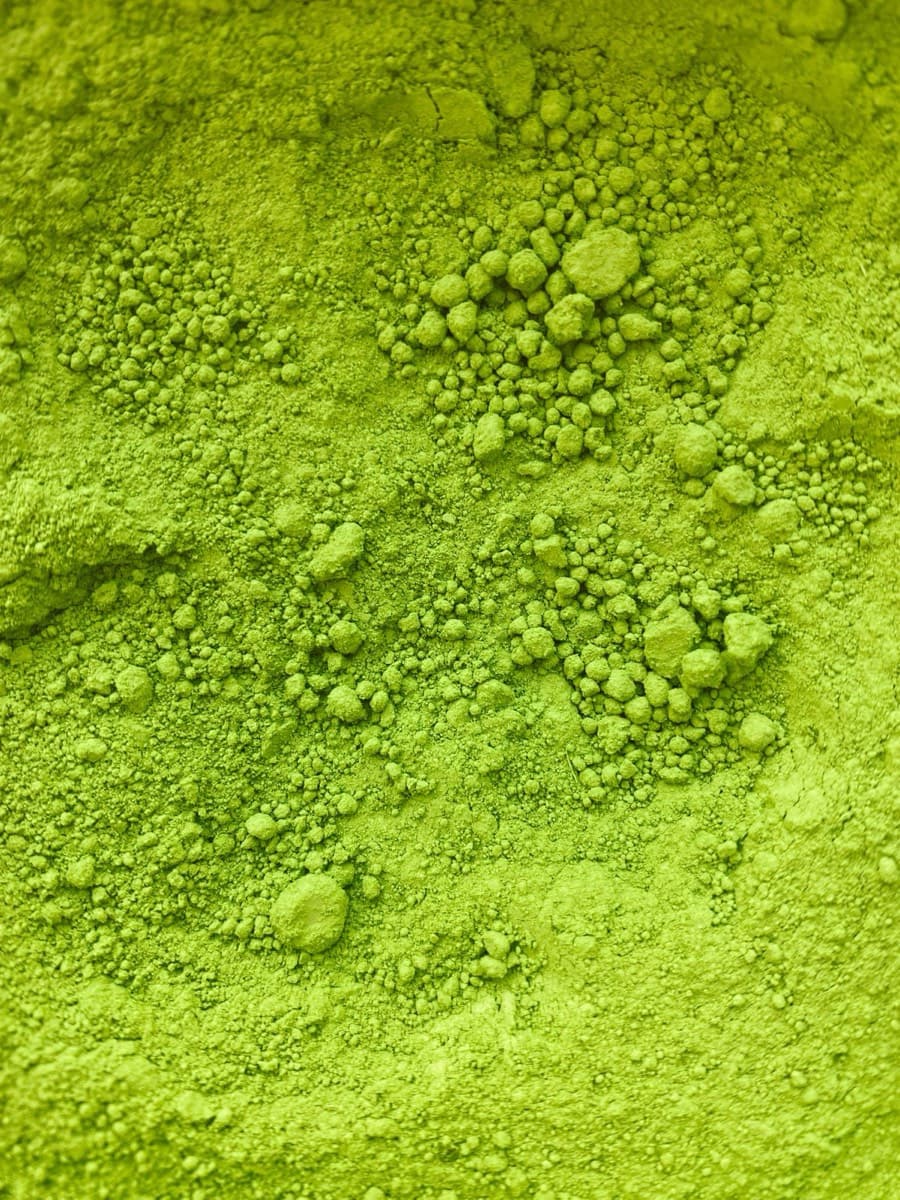
| Color | Vivid jade green | Duller, olive to yellowish green |
| Best for | Whisked with water (usucha, koicha) | Lattes, smoothies, baking, ice cream |
What did lab tests find when comparing grades?
A 2025 study in the journal Plants by Toniolo and colleagues measured three commercial matchas: a first-harvest Uji grade made from buds and first leaves, a lower ceremonial grade from the fourth and fifth leaves, and a summer-harvest food grade. L-theanine fell from about 978 mg per 100 g in the top grade to 849 mg and then 352 mg in the food grade. Caffeine fell from about 473 to 260 mg, and EGCG from about 2,665 to 1,706 mg. Total catechins stayed similar at roughly 5 to 6 grams per 100 grams, while flavonols like rutin and kaempferol rose in the lower grades. The authors note the limit: three samples, one batch each.
Why does shading and harvest time change the taste?
Shading changes the leaf chemistry directly. A 2022 study in the International Journal of Molecular Sciences shaded tea plants at 85 and 95 percent for 20 days and found that "shading increased the theanine and caffeine contents, while decreasing" epicatechin and epigallocatechin, with chlorophyll up to 1.4 times higher than unshaded plants. More theanine means more sweet, savory umami; more chlorophyll means the vivid green color. Later harvests grow through summer sun, so they lose theanine, which is why the Plants study's summer food grade looked so different from the spring grades.
How big is the price gap between drinking and cooking matcha?
Japanese wholesale data shows the gap starts at the farm. Japan's Ministry of Agriculture (MAFF) reports that 2024-crop first-flush tencha averaged 3,891 yen per kilogram, against 1,990 yen for second-flush tencha, roughly half. Across all flushes tencha averaged 3,278 yen, about 2.7 times the price of sencha. Then the boom hit: Jiji Press reported in July 2026 that the average tencha price rose for a fifth straight year in 2025 to 8,562 yen per kilogram, 2.6 times the prior year. Retail tins reflect this, which is why real first-flush drinking matcha is rarely cheap.
When is culinary matcha the better choice?
Whenever the matcha is not the only thing in the cup. Milk, sugar, chocolate and butter bury the delicate sweetness that makes first-flush tea worth its price, while a sharper later-harvest powder still tastes like matcha through all that. On the TeaChat forum, one member reported that inexpensive supermarket matcha was "great for the price" for ice cream and lattes, and another said lower-priced powders "tend to have a sharper flavor profile" that suits those uses. America's Test Kitchen goes the other direction for plain whisked matcha, telling readers simply to "avoid culinary-grade matcha."
What happens if you drink culinary matcha straight?
Usually a bitter, dry, grassy bowl, and the thicker you make it, the worse it gets. TeaChat members who tried thick koicha with food-grade matcha describe it as mouth-drying and harsh, and regulars there say the proper grade "makes a difference." Thin usucha with a decent later-harvest powder is drinkable, especially at the 80°C Ippodo recommends, but it will not have the rounded umami of a first-flush tea. If you plan to drink matcha with water most days, the upgrade to a real drinking grade is the single biggest improvement you can make. Our usucha vs koicha guide covers which grades suit each style.
How do you spot real drinking-grade matcha when shopping?
Ignore the word "ceremonial" and look for what it is supposed to imply: a named producer and named blend, a stated origin, a harvest or production date, and a price that makes sense. Ippodo's top grade, Kanza, is $104 for 20 grams (about $5.20 per gram) as of September 2026, and entry drinking grades from established Uji houses sit around $0.60 to $1.50 per gram. Color is the fastest check once it arrives: vivid jade green points to a shaded first-flush tea, while dull olive or yellowish powder points to later leaf or old stock. Our grade guides walk through real lineups.
Sources
- Plants (MDPI/PMC), 2025 — Comparative multianalytical characterization of different grades of matcha
- International Journal of Molecular Sciences (PMC), 2022 — Effect of shading on matcha green tea
- ISO 20715:2023 — Tea — Classification of tea types (defines matcha)
- Norinchukin Research Institute, May 2026 — The matcha boom and soaring sencha prices (Japanese)
- MAFF, Oct 2025 — The current state of tea (Japanese), flush-by-flush crude tea prices
- Jiji Press, July 2026 — Global matcha boom pushes up tencha prices
- America's Test Kitchen — Matcha
- TeaChat — "Matcha for cooking?"
- TeaChat — "Matcha: Koicha vs Usucha"
- Ippodo — Kanza product page (price check, Sept 2026)
FAQ
Is "ceremonial grade" an official Japanese grade?
No. ISO 20715 defines matcha by how it is grown and made (shaded leaves, steamed, dried without rolling, finely ground) but sets no grades, and the Japan Tea Central Association's matcha definition is explicitly non-binding. Japanese tea houses name their blends and rank them within their own lineup instead. "Ceremonial" is a retail label that any seller can put on any tin, so it tells you what the seller intends the powder for, not that it passed a test.
Can you use ceremonial matcha for lattes?
You can, but most of what you paid for gets hidden. Milk and sweetener mask the delicate sweetness and umami that make a first-flush matcha expensive, while the sharper, more bitter edge of a cheaper powder cuts through milk better. TeaChat regulars have said for years that lower-priced matcha is "excellent for these uses," meaning lattes and ice cream. A good middle ground is an entry-level drinking grade rather than the top of a brand's lineup.
Why is culinary matcha more bitter?
Shading raises L-theanine and suppresses catechin production, and later harvests get more sun. The 2025 Plants comparison found far less theanine in a summer food grade (about 352 mg per 100 g versus 978 mg), while total catechins stayed at a similar 5 to 6 grams per 100 grams. So a lot of the extra bitterness comes from losing the sweet, savory amino acids that normally balance the catechins, not just from adding more bitter compounds.
How can I tell good drinking matcha from a label?
Look for a named producer and blend, a stated origin, a harvest or production date, and a price per gram consistent with a first-flush tea. Ippodo's top grade, Kanza, is $104 for 20 grams (about $5.20 per gram) as of September 2026, while serious entry drinking grades from Uji houses sit closer to $0.60 to $1.50 per gram. A "ceremonial" tin far below that range, with no origin or producer, is probably a later-harvest powder.
Never miss a matcha restock
Join the free Discord community and get an instant alert the moment your grade is back — or sign up to browse live stock across every major Japanese tea house.
Sources
- https://pmc.ncbi.nlm.nih.gov/articles/PMC12157965/
- https://pmc.ncbi.nlm.nih.gov/articles/PMC9696345/
- https://www.iso.org/standard/75419.html
- https://www.nochuri.co.jp/genba/pdf/otr20260514.pdf
- https://www.maff.go.jp/kanto/seisan/engei/tokusan/attach/pdf/index-8.pdf
- https://jijiphoto.photoshelter.com/image/I0000LSl2dg7LdFo
- https://www.americastestkitchen.com/recipes/15571-matcha
- https://www.teachat.com/viewtopic.php?t=8667
- https://www.teachat.com/viewtopic.php?t=10349
- https://ippodotea.com/products/kanza