
Uji vs Nishio vs Kagoshima vs Yame: Does Matcha Region Matter?
Kagoshima grows the most tencha, Uji the priciest. What really differs between Japan's matcha regions, and what "Uji" on a label legally means.
Restocks sell out in minutes — get the alert in Discord.
Join DiscordMost premium matcha tins name a place, and "Uji" is the one everyone knows. But Japan's matcha comes from several regions that grow it very differently, and the biggest producer is not Uji at all. Here is what the official data and regional bodies say actually distinguishes them.
Where is most of Japan's matcha grown?
In the south. Japan's Ministry of Agriculture (MAFF) ranks Kagoshima first, Kyoto second and Shizuoka third for tencha, the shaded leaf that is ground into matcha. National tencha output reached 5,336 tonnes in 2024, about 2.7 times the 2014 level, yet still only about 7.3 percent of Japan's crude tea. A May 2026 Norinchukin Research Institute briefing shows tencha's share of Japanese tea climbing from about 3 percent to about 7 percent between 2015 and 2024. Prices explain why: Jiji Press reported in July 2026 that average tencha prices rose for a fifth straight year in 2025, to 8,562 yen per kilogram.
| Region | Scale | How it's grown | What to expect |
|---|---|---|---|
| Kagoshima (Kyushu) | No. 1 tencha producer | Flat fields, ~98% riding harvesters, early cultivars | Good-value everyday and latte matcha, big volumes |
| Kyoto / Uji | No. 2 tencha producer | Hillsides, ~21% riding harvesters, hand-picked Uji cultivars at the top | The benchmark for premium drinking matcha; highest prices |
| Shizuoka | No. 3 tencha producer | Sencha heartland converting to tencha; 88% Yabukita | Growing supply, mostly newer and machine-picked |
| Nishio (Aichi) | 334 t tencha in 2024 | ~95% of the city's tea is tencha; shelf shading | A matcha specialist region with over a century of focus |
| Yame (Fukuoka) | ~1,870 t crude tea, all types | Mountain villages, gyokuro tradition, straw shading | Small-volume matcha from gyokuro-style producers |
What does "Uji matcha" actually mean?
It is a defined term, and wider than most buyers assume. The Kyoto Prefecture Tea Cooperative Association's 2004 definition says Uji tea is tea grown in the four prefectures of Kyoto, Nara, Shiga and Mie, which developed together as the historic Uji tea area, and finished and processed by Kyoto-based companies inside Kyoto Prefecture, with Kyoto-grown leaf given priority. So "Uji" on a tin guarantees Kyoto finishing and blending plus leaf from that four-prefecture area. It does not guarantee the leaf was grown in Uji city, and it says nothing about grade by itself.
Why is Kyoto matcha the most expensive?
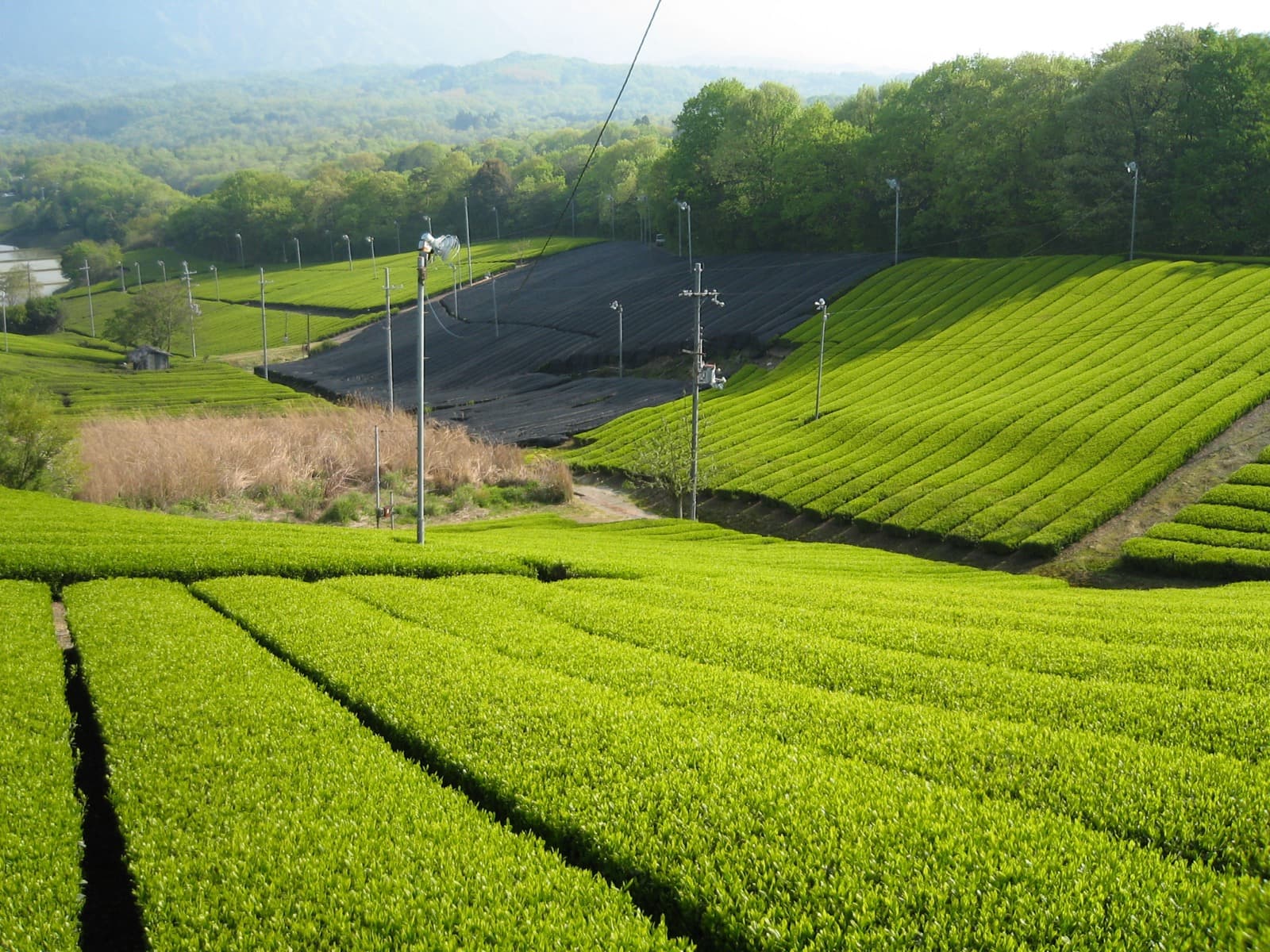
Because of how its best tea is grown. A December 2025 House of Councillors research paper notes only 21.4 percent of Kyoto's tea fields use riding harvesters, against 98.1 percent in flat Kagoshima; Kyoto's hillside plots are small and labor-heavy. Kyoto's prefectural tea research institute says its main tencha cultivars, Asahi, Samidori and Ujihikari, are all grown under intensive hand-picked cultivation and represent the premium end of the Uji brand. The market pays for it: the Global Japanese Tea Association reported that even machine-harvested tencha at the 2026 Uji tea market in Kyoto averaged 17,250 yen per kilogram, the highest since records began in 1996.
How did Kagoshima become the biggest matcha producer?
Scale and conversion. Kagoshima made more crude tea than any other prefecture in 2024, 27,000 tonnes by MAFF's count, and its flat, large farms are almost entirely machine-harvested. As tencha prices climbed, farmers switched sencha fields to tencha, and Kagoshima took the tencha lead. Its cultivar mix is also different: MAFF data for fiscal 2024 shows Yabukita at only 29 percent there, with early cultivars Yutakamidori at 26 percent and Saemidori at 16 percent. A 2025 Tea & Coffee Trade Journal report notes newer regions like Kagoshima and Shizuoka tend to shade by laying cloth directly on the bushes rather than on overhead shelves.
What makes Nishio different?
Focus. Nishio, in Aichi Prefecture, dedicates about 95 percent of the green tea it manufactures to tencha, according to a March 2025 Tea & Coffee Trade Journal report: about 180 hectares and 87 growers produced 334 tonnes of tencha in 2024. Tea arrived there in 1271, and the modern industry began when priest Adachi Jundo brought seeds and methods from Uji in 1872. Growers use shelf shading with double-layer black cloth that blocks roughly 70 percent of light at first and 95 to 97 percent later, and plant Yabukita (about 50 percent), Samidori (30 percent) and Okumidori (20 percent). Aoi Seicha, a Taisho-era family firm we track, is based there.
Is Yame matcha worth trying?
Yes, if you like a gyokuro-style tea house. Fukuoka makes about 1,870 tonnes of crude tea a year, sixth in Japan, and the Fukuoka tea promotion council says its gyokuro and tencha come from Yame's mountain districts, with gyokuro centered on Kurogi, Joyo and Hoshino Village. Tea reached Yame around 1423 with a Zen priest returning from Ming China, and the area is best known for traditional hon-gyokuro, still shaded the old way with rice straw. Hoshino Seichaen, in Hoshino Village, built Kyushu's first tencha factory in 1989 and brought those gyokuro-style shading techniques to matcha. Our Hoshino guide covers its lineup and prices.
Why does Shizuoka make less matcha than you would expect?
Because its fields are planted for sencha. Shizuoka is Japan's second-largest crude-tea producer, yet only third in tencha, and MAFF data shows 88 percent of its tea area is Yabukita. The House of Councillors paper explains the problem: under shade, Yabukita's chlorophyll response is sluggish, so leaves do not turn the vivid green tencha needs, and the shading stresses the plant. Switching to shade-friendly cultivars means replanting, and new bushes take about five years to yield a stable harvest, so Shizuoka's shift to matcha is real but slow. Our cultivars guide explains which varieties suit matcha.
So which region should you buy from?
Match the region to the use. For koicha and the best whisked usucha, the top hand-picked grades from Kyoto's Uji houses remain the benchmark, which is why Ippodo, Marukyu Koyamaen and Nakamura Tokichi sell out first; see our best Uji matcha brand guide. For lattes and everyday drinking, machine-harvested Kagoshima matcha often gives better value. Nishio and Yame houses are strong alternatives when Uji favorites are out of stock, and a producer's own grade ranking always matters more than the region printed on the tin.
Sources
- MAFF, Oct 2025 — The current state of tea (Japanese): prefecture rankings, cultivar mix, prices
- House of Councillors research office, Dec 2025 — Expanding tea exports: the state of matcha supply (Japanese)
- Norinchukin Research Institute, May 2026 — The matcha boom and soaring sencha prices (Japanese)
- Global Japanese Tea Association — Japanese Tea Report, August 2026
- Jiji Press, July 2026 — Global matcha boom pushes up tencha prices
- Kyoto Prefecture Tea Cooperative Association — Definition of Uji tea (Japanese)
- Kyoto Prefectural Tea Research Institute — Uji cultivars (Japanese)
- Tea & Coffee Trade Journal, Mar 2025 — Nishio remains at the center of matcha production in Japan
- Fukuoka Prefecture Tea Promotion Council — Yame tea overview (Japanese)
- Fukuoka Prefecture Tea Promotion Council — Yame tea features and history (Japanese)
- Kien Yu & Co. — About AOI Seicha
FAQ
Does "Uji matcha" mean it was grown in Uji?
Not necessarily. Under the definition the Kyoto Prefecture Tea Cooperative Association set in 2004, Uji tea is tea grown in Kyoto, Nara, Shiga or Mie prefectures and finished by Kyoto-based companies inside Kyoto Prefecture, with Kyoto-grown leaf given priority. So "Uji" tells you who finished and blended the tea and that the leaf came from the wider historic Uji area, not that it came from Uji city itself.
Is Kagoshima matcha worse than Uji matcha?
Not automatically. Kagoshima is now Japan's biggest tencha producer and its flat, mechanized fields make good matcha efficiently, which is why a lot of affordable latte and everyday matcha comes from there. What it rarely offers is the hand-picked, shelf-shaded, Uji-cultivar tea that tops Kyoto tea houses' lineups. For a latte, Kagoshima matcha is often the smarter buy; for koicha, the top Uji grades still set the benchmark.
Which region produces the most matcha?
By tencha volume, Kagoshima. Japan's agriculture ministry ranks Kagoshima first, Kyoto second and Shizuoka third for tencha, and Kagoshima's farmers have been converting sencha fields to tencha as prices climb. National tencha output reached 5,336 tonnes in 2024, about 2.7 times the 2014 level, and Jiji Press reported the average tencha price rose for a fifth straight year in 2025.
Which tracked brands come from outside Uji?
Hoshino Seichaen is in Hoshino Village in Yame, Fukuoka, and built Kyushu's first tencha factory in 1989. Aoi Seicha is a Taisho-era family business in Nishio, Aichi. Most of the other houses we track, including Ippodo, Marukyu Koyamaen, Nakamura Tokichi and Horii Shichimeien, are Kyoto-based Uji houses. You can set restock alerts for all of them.
Never miss a matcha restock
Join the free Discord community and get an instant alert the moment your grade is back — or sign up to browse live stock across every major Japanese tea house.
Sources
- https://www.maff.go.jp/kanto/seisan/engei/tokusan/attach/pdf/index-8.pdf
- https://www.sangiin.go.jp/japanese/annai/chousa/rippou_chousa/backnumber/2025pdf/20251202087.pdf
- https://www.nochuri.co.jp/genba/pdf/otr20260514.pdf
- https://gjtea.org/japanese-tea-report-august-2026/
- https://jijiphoto.photoshelter.com/image/I0000LSl2dg7LdFo
- https://ujicha.or.jp/enjoy/society/
- https://www.pref.kyoto.jp/chaken/mame_ujihinnshu.html
- https://www.teaandcoffee.net/feature/36475/nishio-remains-at-the-center-of-matcha-production-in-japan/
- https://fukuoka-yamecha.jp/gaiyo/
- https://fukuoka-yamecha.jp/whats/
- https://www.kienyu.com/matcha-aoi/